
When a dispute arises, the first response is rarely calm or analytical. It is usually frustration, anxiety, or a sense that something has gone wrong and needs to be fixed quickly. In India, that instinct often leads people straight to court. Litigation feels familiar. It feels authoritative. It feels final.
But going to court is only one of several ways to resolve a dispute. Arbitration and mediation are no longer fringe alternatives. They are structured, legally recognised processes that, in many cases, offer better outcomes with less damage along the way. The real difficulty lies in choosing the right path early, before positions harden and costs spiral.
This article looks at litigation, arbitration, and mediation from a practical lens, not as legal theory, but as real choices people and businesses must make.
Why This Choice Matters More Than It Seems
Disputes do not exist in isolation. A commercial conflict can stall operations and strain long-standing partnerships. A family dispute can drain emotional energy for years. Even a relatively small disagreement can grow into something far larger if handled poorly.
The method you choose shapes everything that follows. It affects how long the dispute lasts, how much it costs, whether details become public, and whether any working relationship survives at the end. Too often, people focus only on legal strength and overlook these practical consequences.
Choosing the right forum is not about weakness or compromise. It is about strategy.
Litigation: The Authority Of The Courts
Litigation is the formal process of resolving disputes through courts. It involves pleadings, hearings, evidence, and eventually a judgment delivered by a judge. For many disputes, especially those involving criminal allegations, public law issues, or urgent relief, litigation is unavoidable.
Courts have powers that no other forum does. They can grant injunctions, freeze assets, summon parties, and enforce compliance through state machinery. For disputes where authority and compulsion are essential, litigation remains the strongest option.
That strength comes with trade-offs. Court proceedings are public, and sensitive facts often enter the public domain. Timelines are uncertain, largely due to heavy caseloads and procedural delays. What begins as a straightforward case can stretch into years of hearings and adjournments.
There is also the human cost. Litigation is adversarial by nature. It often deepens conflict rather than resolving it, particularly in disputes involving families, partners, or closely held businesses.
Arbitration: Private, Structured, And Binding
Arbitration sits somewhere between litigation and negotiation. It follows a legal process, but in a private setting. Parties appoint an arbitrator, or a panel, to hear their dispute and deliver a binding decision known as an arbitral award.
In India, arbitration is widely used in commercial contracts, infrastructure projects, shareholder disputes, and cross-border transactions. One of its key advantages is confidentiality. Proceedings are not open to the public, which helps protect business interests and reputations.
Arbitration also allows parties to select decision-makers with subject expertise, something courts cannot always offer. This can be valuable in technical or industry-specific disputes.
However, arbitration is not always faster or cheaper than court proceedings. Complex arbitrations can take considerable time, and professional fees can be substantial. Another important aspect is finality. Courts interfere with arbitral awards only on limited grounds, which means there is little scope for appeal even if one party is dissatisfied.
Arbitration works best when parties understand the process and are prepared to engage seriously with it.
Mediation: Resolving Disputes Through Conversation
Mediation takes a fundamentally different approach. Instead of deciding who wins, it focuses on finding a solution both sides can accept. A mediator facilitates discussion, helps clarify issues, and guides negotiation, but never imposes a decision.
The Mediation Act, 2023 has strengthened this process by recognising mediated settlements and encouraging institutional mediation. For many commercial disputes, pre-litigation mediation is now mandatory, reflecting a broader push towards early resolution.
Mediation is especially effective where relationships matter. Family disputes, partnership conflicts, workplace disagreements, and even neighbourhood issues often benefit from a less confrontational process. It is usually quicker, less expensive, and far less emotionally draining than litigation.
That said, mediation depends on willingness. If one party is determined not to settle, mediation may not succeed. It also requires careful handling where there is a power imbalance between parties.
When it works, mediation resolves not just the dispute, but much of the bitterness surrounding it.
Understanding The Real Differences
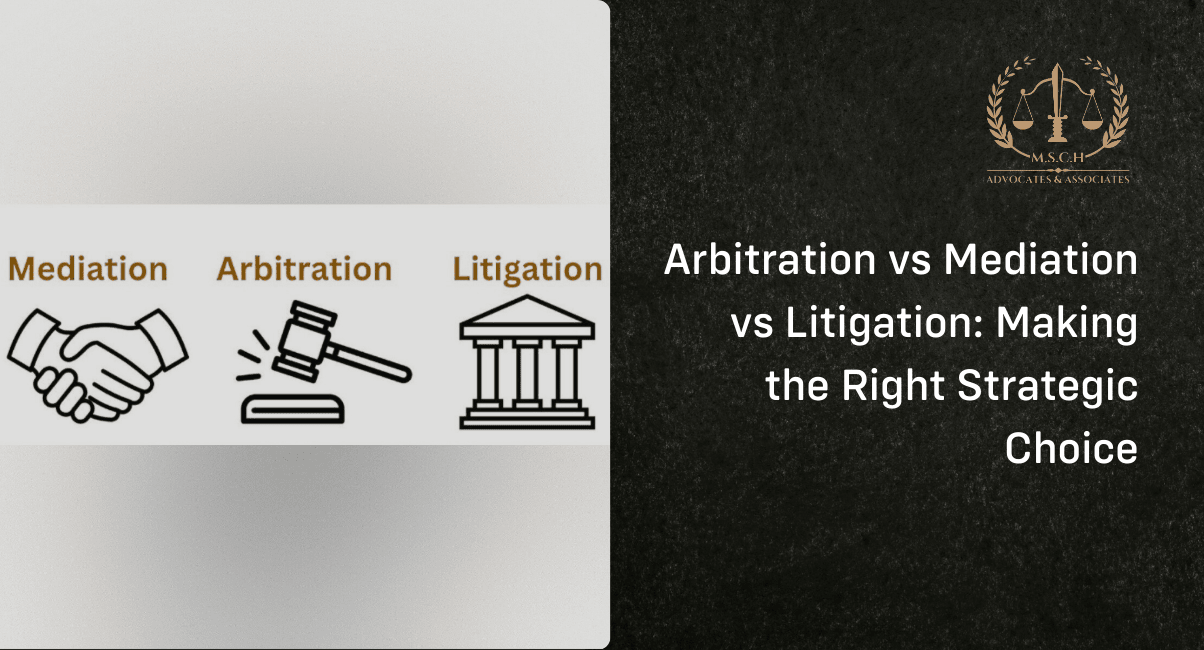
Rather than viewing litigation, arbitration, and mediation as competing systems, it helps to see them as tools designed for different problems.
Litigation offers authority, enforceability, and precedent, but moves slowly and publicly. Arbitration offers privacy and finality, but can be rigid and costly. Mediation offers flexibility and speed, but relies on cooperation and trust.
No option is universally superior. The right choice depends on what you value most in that moment.
Common Concerns Clients Have
Clients often worry about time. Mediation is usually the fastest route to resolution. Arbitration timelines vary depending on complexity. Litigation is the least predictable.
Privacy is another frequent concern. Court proceedings are open. Arbitration and mediation are confidential.
Cost is often misunderstood. Mediation is typically the most affordable. Arbitration costs depend heavily on the nature of the dispute. Litigation spreads costs over time, which can mask its true expense until much later.
Clients also ask about enforceability. Court judgments and arbitral awards are binding. Mediated settlements become binding once formally recorded, but they begin with voluntary agreement.
The Role Of Recent Legal Changes
India’s legal framework now actively encourages alternative dispute resolution. Mandatory pre-litigation mediation reflects a shift away from reflexive court battles. The Mediation Act, 2023 gives mediation greater legitimacy and structure, increasing confidence in negotiated outcomes.
Ignoring these developments can lead to procedural hurdles or missed opportunities for early settlement.
Making The Right Strategic Choice
If your dispute requires urgent court intervention or involves serious legal violations, litigation may be necessary. If you need a private, binding decision in a commercial context, arbitration may be appropriate. If preserving relationships, saving time, and reducing stress are priorities, mediation should be considered seriously.
The best choice is not always the most aggressive one. It is the one that aligns with your real objectives.
Final Thoughts
Disputes are rarely resolved by law alone. They are shaped by the forum chosen, the tone adopted, and the willingness to think beyond winning and losing.
Many disputes in India escalate simply because the wrong path is chosen at the outset. A moment of reflection at the beginning can prevent years of unnecessary conflict.
The law offers multiple routes to resolution. Choosing wisely is not just a legal decision. It is a strategic one.